How to Choose Portable Fans for Wholesale: Battery Capacity and Wind-Speed Control
Choose portable fans by the job the end user will do with them, not by the biggest battery number. Read mAh together with the working-time range, and match speed levels to the scenario.
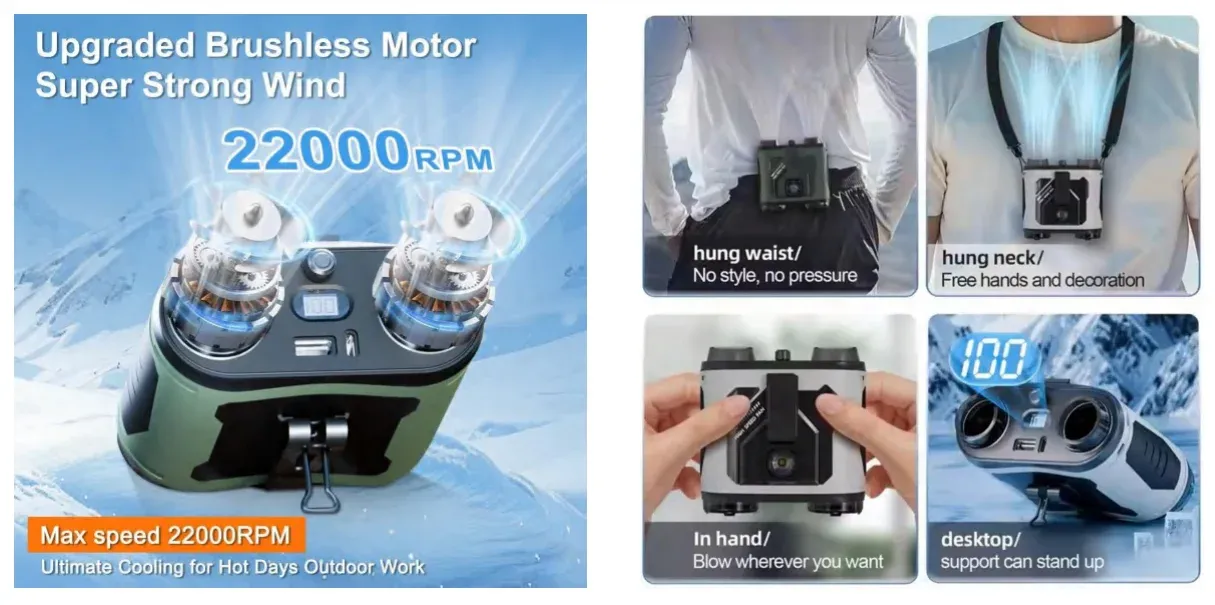
Choose portable fans by the job the end user will do with them, not by the biggest battery number on the list. Battery capacity in mAh only becomes meaningful when it is read together with the fan's working-time range, and wind-speed levels only matter when they match how precisely the user needs to control airflow. A 1000mAh clip-on, a 3600mAh handheld and a 20000mAh waist fan are not better or worse versions of one product; they are answers to three different selling situations.
When the Spec Sheet Looks Right and the Fan Still Disappoints
Picture a familiar first order. A buyer compares a page of fan listings, picks the model with the largest battery in its price band and a long list of speed levels, and places a trial order for a summer promotion. The fans arrive, the first retail feedback comes back, and it is not about build quality. Commuters say the fan dies before the evening trip home because they ran it near full speed all day. Desk users say the lowest setting is still too strong in their face, because three coarse levels jump from too weak to too much. The buyer did nothing careless; the numbers were real. They were just read as a ranking, when they should have been read as a match between a battery, a speed system and a daily routine.
Why mAh Alone and Level Counts Mislead
Battery capacity looks like the easiest comparison in the category, and it is the most misleading one. In the Joysame 2027 catalog, the FC5 waist fan carries a 6000mAh battery and a stated working time of 3 to 14 hours. The K88 multi-function fan carries the same 6000mAh and states 5.5 to 18 hours. Same capacity, different runtime ranges, because motor design, outlet size and the speed the user selects all draw on the battery at different rates. The pattern repeats at the top of the range: the N610 waist fan pairs 10000mAh with 8.5 to 33 hours, while the N611 pairs 20000mAh with 12 to 60 hours. Doubling the battery does not double the hours at the settings people actually use, and the wide gap inside every range is the speed dial doing its work. A fan run at its top level can use its battery several times faster than the same fan at a low level, so the honest figure to compare is the working-time range, not the mAh headline.
Speed levels mislead in the opposite direction. A high level count sounds like stronger wind, but it describes control, not power. In this catalog the range runs from 3 levels on mini clip fans such as the K83C and FC12, through 5 levels on models such as the N607 and N611, up to 100 levels on handhelds such as the FC3 and K93, and even 199 stepless levels on the L102. A 3-speed fan is not a weak fan; it is a simple fan, and for a clip-on used at one distance from the body, three steps may be all the control the user wants. A 100-level fan earns its complexity when the user sits close and needs fine steps between a whisper and a blast, or when a retailer wants one model to cover many preferences. Counting levels without asking who needs that granularity is how a buyer pays for control nobody uses, or ships a coarse fan into a scenario that needed a fine one.
Matching Battery and Speed Control to the Selling Scenario
For commuting and everyday handheld use, the working day is a few hours of intermittent cooling, and weight matters as much as runtime. Batteries from 2000mAh to 4000mAh fit this scenario: the N615 pairs 2000mAh with 3 speeds in a pocketable body, while the FC3 and the K93 pair 3600mAh and 4000mAh with 100-level control for users who adjust constantly on trains, in queues and at outdoor events. This is the volume scenario for most retail programs, and it rewards a balance of size, control and a working-time range that covers a day of mixed use.
For desk use, the fan runs for long stretches at close range, so fine control matters more than raw capacity. Stepless or 100-level models let a user park the airflow exactly below the point where papers move and eyes dry out, and mid-size batteries are enough because the fan is recharged where it sits. A foldable handheld such as the FC3, which also stands on a desk, covers this scenario and the commute with one SKU, which simplifies a first assortment.
For outdoor work and camping, runtime is the product. This is where 10000mAh and above earns its size and weight: the N610 states 8.5 to 33 hours and the N611 states 12 to 60 hours, both at 5 speeds, because a work crew or a campsite needs dependable steps and maximum hours rather than fine gradations. The folding D1201, at 12000mAh with a stated 4.5 to 50 hours, serves the campsite version of the same need. In this scenario, also read the charging time before you order: a battery that runs for days but needs 9.5 hours to recharge, as the N611 does, has to fit the user's overnight routine.
For gift and promotion programs, simplicity is the specification. Small clip-on and mini fans at 1000mAh to 2000mAh, such as the 1000mAh K83C clip-on at 142g or the 1000mAh FC12, give a recipient a fan that works out of the box with 3 speeds and no learning curve. The buyer is purchasing a low unit cost, a light carton and a product a non-technical recipient cannot set wrong, and a long level list adds nothing to any of those.
What the Numbers Do Not Tell You, and What to Verify with Samples
A spec sheet cannot tell you how loud a fan is at the level a desk user will pick, how the airflow feels at arm's length, how strong a clip feels after a month on a waistband, or how a battery ages after a season of daily charging. It also leaves some printed figures unexplained. Many models in this catalog list two product weights, such as 254g/351g, without stating what each value represents, so ask the supplier what the two values mean before you print either one in your own listing. Working-time ranges are printed without the test conditions behind them, so ask at which speed each end of the range was measured, and what the runtime is at the middle settings your customers will use most. Ask how long a full charge takes, what is included in the box, and how the product is packaged. Then verify the answers on samples: run the fan at the levels your scenario depends on, time it, wear it, clip it, and listen to it. The sample is where battery and speed claims become real, and it is far cheaper to find a mismatch there than in a container.
The Next Step
Start from the scenario your channel sells into, then shortlist fans whose working-time range and speed system fit that scenario, and only then compare prices inside the shortlist. If you are building a first assortment, the K93 handheld fan, with 4000mAh and 100-level control, is a useful reference point for the commuting and desk scenarios, and the wider Joysame portable fan range covers the clip-on, waist and folding formats described above. For quantity pricing, samples and OEM/ODM options, send an inquiry through the Contact page or WhatsApp +86 13760337725, and include the scenario you are buying for so the recommendation can start from the right battery class.